
Emergency freight is a time-critical, coordinated transport response built to protect production continuity. It is not just premium shipping with a higher price tag.
This guide walks through a practical sequence: assess the risk, gather shipment data, pick the right air or ground mode, prepare the receiving plant, and build a repeatable prevention plan.
Key Takeaways
- Compare expedite cost against the full cost of downtime before deciding.
- Early escalation, complete shipment data, and one accountable owner keep more options open.
- The fastest answer may be ground, charter, helicopter, or a mix.
- Post-incident reviews and prequalified providers cut repeat shutdowns.
Why Plant Shutdowns Happen and When Emergency Freight Is Justified
Common triggers
Most freight-related stoppages trace back to a short list of causes:
- Supplier production delays or missed pickups
- Carrier breakdowns or no-shows
- Damaged or rejected loads
- Customs or border holds
- Equipment failures needing a replacement part
- Single-source components with no alternate
Classify by operational impact
Not every late shipment deserves an emergency response. Sort each one into a tier:
- Line-down critical: production is stopped or will stop before any standard option arrives.
- Production-risk: inventory coverage is thin and a stoppage is likely without action.
- Customer-commitment risk: the line runs, but a delivery promise is in jeopardy.
- Recoverable delay: schedule slips can be absorbed with no premium move.
Weigh the premium against the exposure
Fluke's U.S. release puts average downtime cost at $400K per hour, though that figure is a survey average and not a freight-specific loss. Contract penalties can be harsher. Navistar's supplier guidelines list line-downtime charges of $1,000 per minute at named plants.

Use your own plant's hourly figure. If a premium move costs less than a few hours of idle line, the decision is usually easy.
Immediate Response to a Plant Shutdown Risk
Name one incident owner
Assign a single person to coordinate production, maintenance, purchasing, shipping, receiving, the supplier, and the logistics provider. One voice prevents conflicting instructions and slow approvals.
Gather quote-ready information
A provider can only move as fast as your data. Have these ready:
- Pickup and delivery addresses, with on-site contacts
- Ready time and must-arrive-by time
- Piece count, dimensions, weight, commodity, and packaging
- Declared value, hazmat status, and temperature needs
- Loading equipment and delivery restrictions
Define the real deadline
Document remaining production coverage, the time the line will stop, the restart sequence, and any customer or contractual consequences. "ASAP" is not a deadline. A must-arrive-by time lets the provider choose the right mode.
Total the cost of downtime
Siemens' downtime cost research frames the categories: lost output, idle and recovery labor, emergency parts, and contractual compensation. Add overtime, scrap, and rescheduling from your own records. Then set that total against the freight quote.
Confirm both ends are ready
- Freight staged, labeled, and accessible after hours
- Forklifts or loading equipment on hand
- Security access approved for the driver or crew
- Receiving staff briefed to unload and route the part straight to the line
Choosing and Executing the Right Emergency Freight Mode
Dedicated ground expedite
Ground works when distance is moderate and the freight fits a vehicle. Direct routing means no other customers' freight and fewer handoffs.
Expedite carriers such as FedEx Custom Critical publish payload requirements of:
- 2,500 lb for cargo vans
- 5,000 lb for small straight trucks
- 13,000 lb for large straight trucks
Team drivers can extend range, but federal hours-of-service rules still cap each driver at 11 hours of driving after 10 hours off duty. Check that the math works for your deadline.
McMahon Airborne Logistics runs its own ground vehicles in Southeast Michigan. Outside that area, partner carriers supply sprinter vans and straight trucks.
Air freight and air charter
Next-flight-out options can be cheap but depend on schedules and connections. Dedicated charter gives you exclusive capacity and schedule control. Aircraft vary widely: the Cessna SkyCourier freighter carries about 6,000 lb, while an MD-83F is published at 45,000 lb.
McMahon brokers jet and turboprop capacity through FAA-licensed Part 121 and Part 135 carriers. Sourcing time is stated at 15 minutes, with non-scheduled U.S. charters up to 30,000 lb.
Helicopter freight
Helicopters suit short- and medium-range premium freight, sites far from convenient airports, and difficult final miles. Landing at or near the plant avoids airport transfers and extra handling.
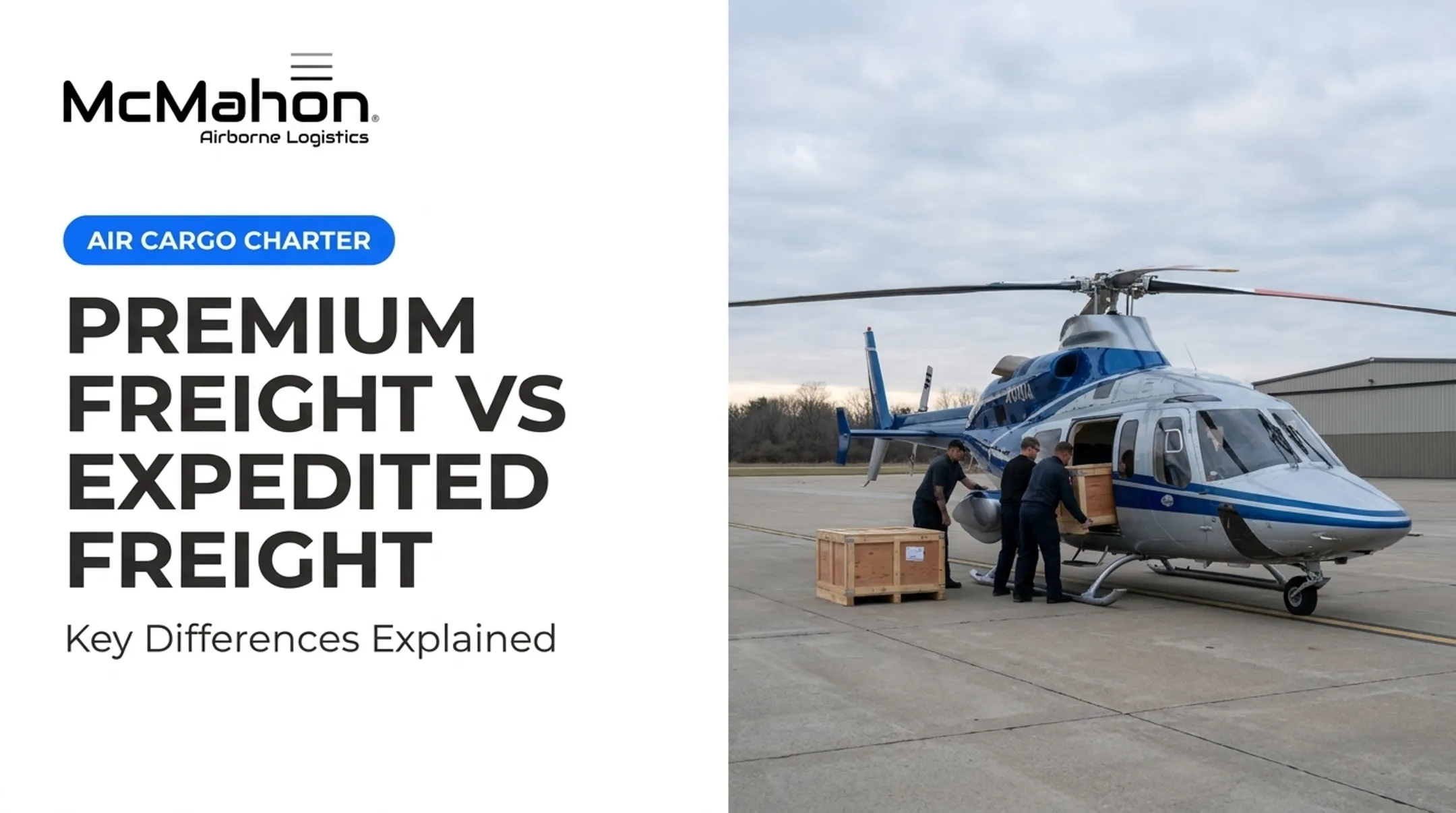
McMahon operates its own twin-engine Bell 430 helicopters, with capacity up to 1,400 lb per aircraft, 160 mph cruise speed, and an effective coverage radius of about 600 miles. It needs no runway, so small airports closed to jets become usable.
If no viable landing spot exists at your facility, teams time the transfer from the nearest airport and arrange ground service. Feasibility depends on the cargo, site, and regulatory requirements.
Compare total door-to-door time
Flight time alone misleads. IATA's cargo handling guidance includes security clearance, document checks, build-up, loading, unloading, and final delivery as separate steps. Add pickup, airport transfers, plant access, and unloading to get the true clock.

A hybrid often wins. Fly the single critical component and send related materials by dedicated ground. Air Charter Service documented a case where 36 urgent boxes out of 700-plus were pulled, flown from Texas to Tennessee by Learjet, and trucked to the plant before the line shut for the night.
Execution and visibility controls
- Get routing confirmed in writing
- Require live tracking and milestone updates
- Ask for a contingency route or aircraft option
- Keep chain-of-custody records and proof of delivery
- Confirm the part reached the production area, not just the dock
McMahon tracks shipments through its web and iOS apps with maps and chat, though map tracking is unavailable on third-party ground segments.
Building a Preventive Emergency Freight Plan
Identify production-critical freight
List the components, tooling, raw materials, and spares that would stop or slow the line. For each item, record:
- Supplier and alternate source
- Inventory coverage
- Transport requirements and approved modes
- Receiving instructions
NIST's supply chain mapping guidance recommends including Tier 2 and 3 suppliers, where hidden dependencies often sit.
Set escalation triggers and approval rules
Base triggers on your own numbers: remaining production coverage, supplier failure, carrier exceptions, inventory thresholds, or customer deadlines. Then document decision rights:
- Who authorizes premium freight
- Who talks to the plant
- Who approves alternate suppliers
- Who makes the final go/no-go call
Prequalify a logistics provider
Look for:
- 24/7 quoting and coordination
- Both air and ground capability
- Access to dedicated equipment
- Door-to-door planning and tracking
- Experience with manufacturing freight
A provider that coordinates several modes beats a single-mode carrier during a line-down event, because it can switch approaches without restarting the search.
McMahon Airborne Logistics as an integrated option
McMahon, founded in 1980 and based in Canton, Michigan, is an FAA Part 135 air carrier, USDOT-licensed ground carrier, and charter broker. It accepts premium-freight requests around the clock and handles emergency parts shipments in what it calls the Red Zone™, covering protect times of roughly zero to eight hours.

It can evaluate airport-based and airport-optional solutions based on shipment specs, target delivery time, and site access. Aircraft, route, and delivery time are confirmed only at quote.
Standardize the checklist and communication tree
Build one reusable checklist covering:
- Cargo details, contacts, and deadlines
- Documents, loading, and unloading needs
- Security, tracking expectations, and billing approval
- Backup plans
Pair it with a communication tree linking production, maintenance, procurement, logistics, suppliers, carriers, security, and receiving so everyone hears the same ETA and exceptions.
Learn from every emergency shipment
Run a review after each event:
- Root cause and first point of visibility
- Escalation timing and mode chosen
- Provider performance and receiving readiness
- Documentation problems
- Actual production impact
Feed the findings into safety stock, supplier controls, routing guides, approved providers, and escalation thresholds.
Conclusion: Turn Emergency Freight Into a Plant-Continuity Strategy
Emergency freight works best as a planned capability: defined triggers, accurate data, flexible modes, a ready receiving dock, and clear accountability. Plants that prepare before the crisis spend less time deciding and more time moving.
To discuss an urgent shipment or build a contingency plan for production-critical freight, call McMahon Airborne Logistics at 1-800-752-8590 (option 1), available 24/7.
Frequently Asked Questions
What is emergency freight for plant shutdown prevention?
It is a coordinated, time-critical air or ground transport response that delivers production-critical materials before or during a line-down situation. The goal is protecting uptime, not just speeding a package.
When should a manufacturer escalate to emergency freight?
Escalate when remaining production coverage is shrinking, a supplier or carrier failure is confirmed, or a critical replacement part or customer commitment is at risk. Compare the downtime exposure with the expedite cost.
Which transportation mode is best for a line-down shipment?
It depends on size, distance, deadline, site access, handling needs, and total door-to-door time. Dedicated ground, air freight, air charter, and helicopter each fit different situations, and hybrids are common.
What information is needed for an emergency freight quote?
Pickup and delivery details, ready and required-by times, dimensions, weight, piece count, commodity, handling requirements, loading equipment, and contact information.
Can helicopters be used to deliver production-critical freight?
Yes, for certain short- or medium-range premium missions, especially where airport or direct site access shapes the plan. Feasibility depends on the aircraft, cargo, site, and regulatory requirements.
How much does emergency freight cost compared with plant downtime?
Pricing varies by mode, distance, cargo, urgency, and access needs. Weigh the premium against lost production, labor, penalties, recovery costs, and customer impact.