
This is the gap priority air charter fills.
Unlike a seat on a scheduled airline or a slot in a commercial freight network, priority air charter lets a provider build a mission around your deadline, selecting the aircraft, airport, and route that get your shipment or passengers moving now, not whenever the next flight happens to leave.
If you're researching a company called Priority Air Charter, or a similarly named provider, you probably have real questions: Is this a legitimate operator? Who owns it? What will a flight actually cost? These deserve straight answers, not sales copy.
This article breaks down what priority air charter covers, how aircraft get selected, what safety credentials matter, how pricing works, and where McMahon Airborne Logistics fits into time-critical U.S. logistics.
Key Takeaways
- Priority air charter is on-demand aviation for urgent cargo, passengers, or small-airport missions.
- Aircraft selection depends on weight, dimensions, passengers, distance, and airports; no single type fits every mission.
- A charter quote is mission-specific; flight time alone never sets the final price.
- Verify the legal entity, FAA operating authority, and ownership of any provider before booking.
What Priority Air Charter Means and Who Uses It
Priority air charter differs from scheduled airline service in a fundamental way: the customer, not a published timetable, drives the schedule. Under federal aviation regulations, qualifying on-demand operations allow departure time and departure/arrival locations to be negotiated directly with the customer, covering passenger flights, certain all-cargo operations, and rotorcraft missions. The FAA definition of on-demand operation draws a clear line between this kind of charter and larger, pre-scheduled supplemental flying. That flexibility matters when delay is not an option:
- Production-critical parts that can stop a manufacturing line if they arrive late
- Aircraft-on-ground (AOG) shipments where a grounded plane is costing money every hour
- Urgent equipment moves between plants or job sites
- High-value or sensitive freight that needs controlled handling
- Emergency supplies for locations standard carriers can't reach fast enough
- Executive or specialist passenger travel when commercial routing won't make the meeting
Who's Actually Booking These Flights
Automotive OEMs and tier suppliers are among the heaviest users, largely because a single stalled assembly line can cost far more per hour than any charter flight. Aerospace and energy manufacturers book for the same reason: downtime is expensive, and a missing part often triggers a cascading schedule problem. Before booking with any provider, ask three questions:
- Who physically operates the aircraft?
- Who coordinates ground pickup and delivery?
- Is this company a direct carrier, a broker arranging capacity through other operators, or both? An integrated provider that holds its own operating authority and arranges partner capacity—plus ground coordination—can simplify communication. You are not managing separate vendors for the air leg and the ground legs. "Priority Air Charter" may be a specific company's name, or it may be used descriptively across the industry to mean on-demand charter in general. Don't assume a search result is a single entity. Confirm the exact legal name, website domain, and regulatory registration before treating any claims as fact.
Priority Air Charter Services and Aircraft Options
The right aircraft for a time-critical mission depends on what you're moving, how far, and where it needs to land.
Urgent Air Cargo Charter
For shorter-range, time-sensitive freight, helicopter cargo charter solves a problem fixed-wing aircraft can't: airports become optional.
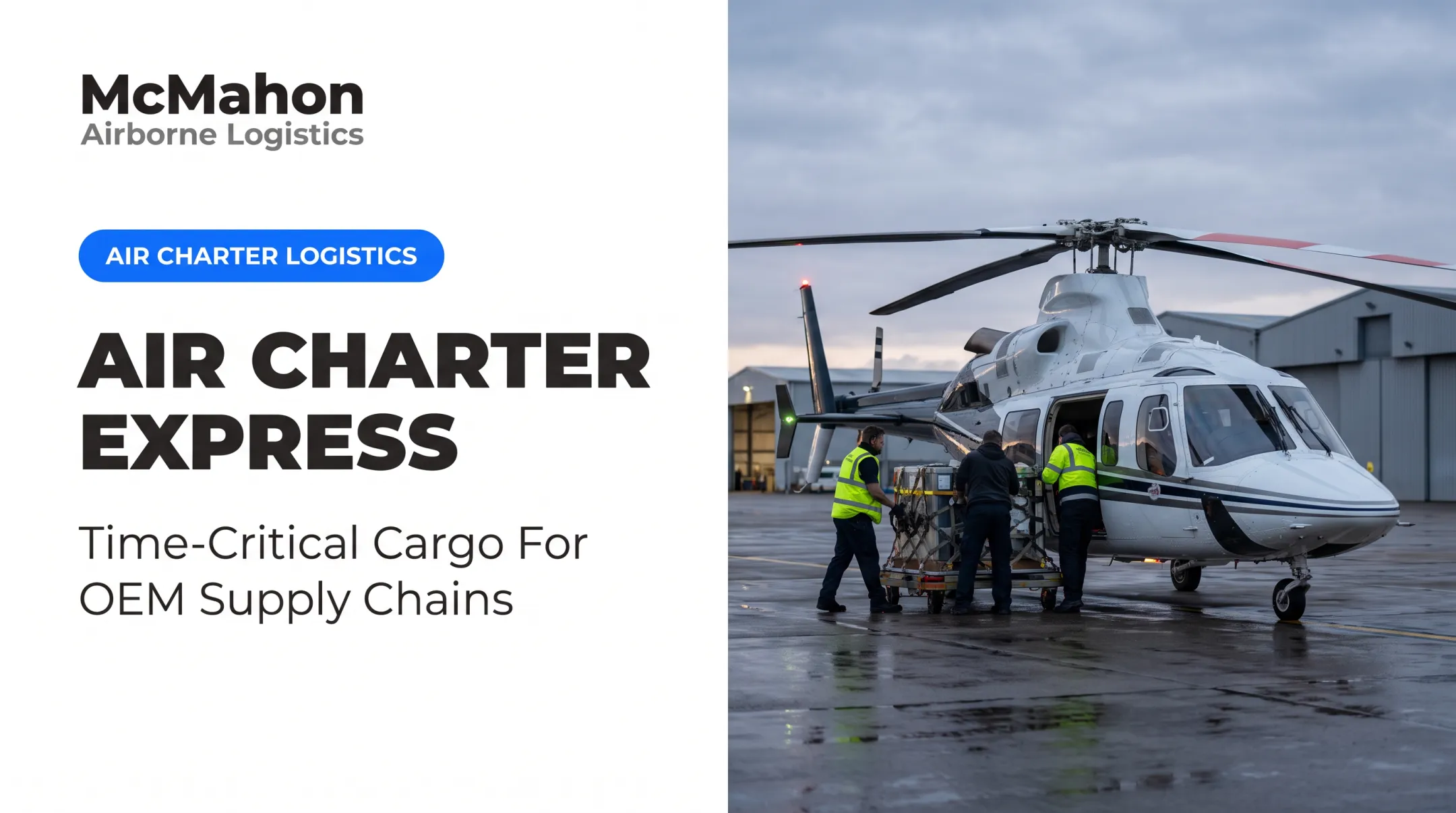
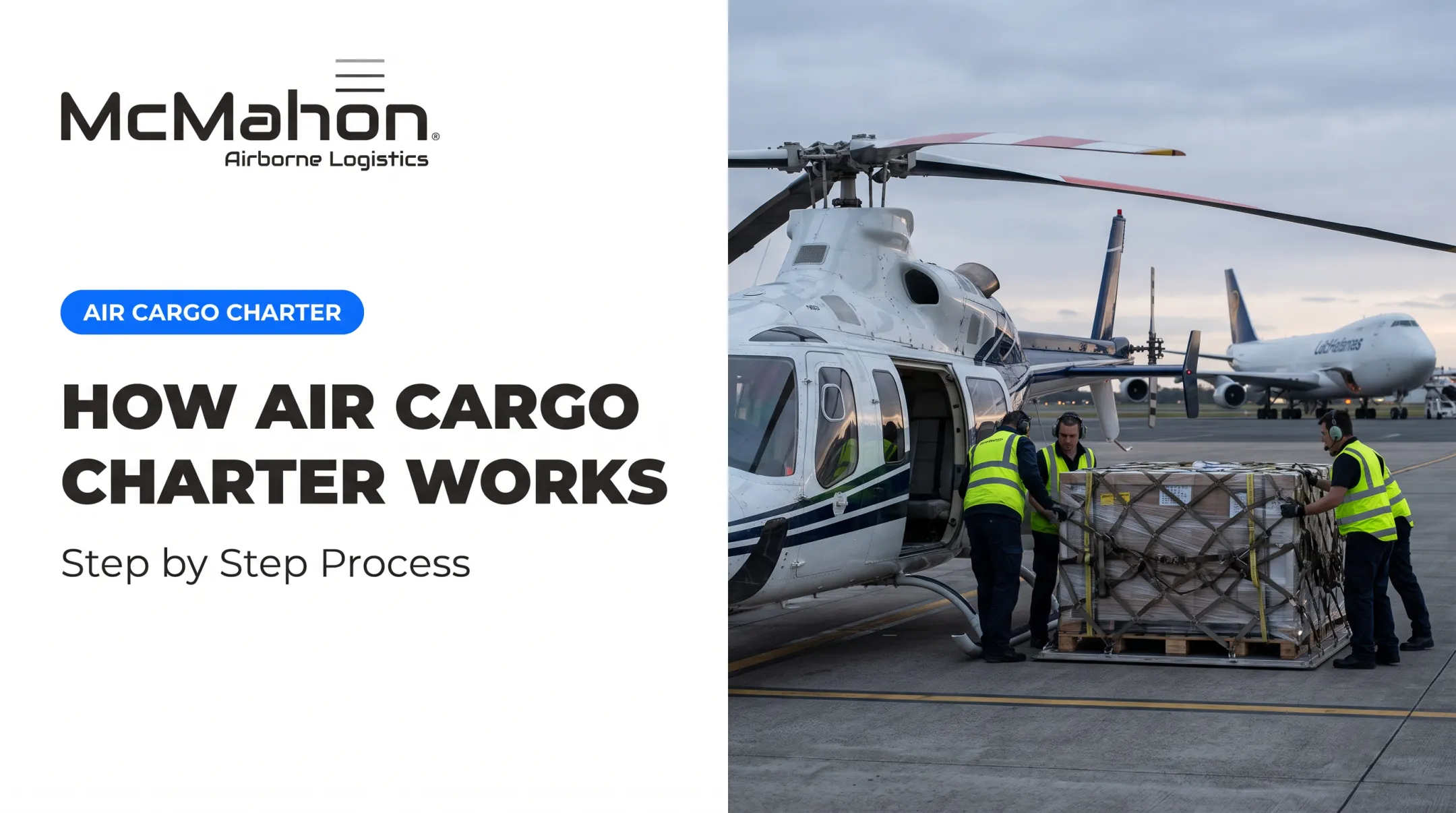
McMahon Airborne Logistics runs a plant-to-plant freight service built around a 15-minute launch time and roughly a 600-mile effective coverage radius. Each helicopter carries up to 1,400 pounds on forklift-loadable pallets or returnable containers. That setup matters most when a part must move facility-to-facility without routing through a commercial airport.

Confirming weight, dimensions, and handling requirements up front isn't optional paperwork. It determines whether the aircraft, fuel load, and landing site actually work together.
Passenger and Executive Movement
Beyond cargo, time-sensitive personnel moves follow similar logic: project teams bound for a remote job site, or executives headed somewhere scheduled airlines serve poorly. Helicopters can be reconfigured quickly between cargo and passenger roles when mission requirements shift on short notice.
Helicopter Access for Remote or Constrained Sites
Helicopter charter fits priority logistics because landing doesn't require a runway. Airport size only matters when you need fuel or ground-handling services.
Landing feasibility still depends on aircraft capability, site conditions, weather, and regulatory permissions. Those factors are reviewed mission by mission, not assumed from a brochure.
Jet and Turboprop Options for Longer Range
For shipments or passenger groups that fall outside helicopter range, jet and turboprop aircraft through carrier partners extend coverage across longer distances or higher payloads. These flights run through FAA-licensed Part 121 and Part 135 carriers, with the charter coordinator managing routing, airport/FBO selection, and ground delivery on both ends.
Aircraft-selection factors at a glance:
| Factor | Why It Matters |
|---|---|
| Distance | Determines helicopter vs. fixed-wing, and whether a fuel stop is needed |
| Payload/dimensions | Drives aircraft size and loading method |
| Passenger count | Affects cabin configuration and fuel planning |
| Landing-site access | Decides whether an airport, FBO, or off-airport site works |
| Urgency/deadline | Shapes launch timing and routing choices |
| Weather | Affects both fixed-wing and rotorcraft dispatch decisions |
| Shipment sensitivity | Influences handling, packaging, and aircraft type |
For missions covering the continental U.S., coordinating both the flight and the ground pickup/delivery through one provider removes a layer of vendor-to-vendor handoffs that otherwise eat into your protect time.
Safety and Operational Reliability
Speed means nothing if the aircraft, crew, or paperwork aren't verified. Before booking any priority charter, confirm:
- The actual operating carrier — not just the broker's name on the quote
- Applicable FAA authorization for the aircraft and mission type
- Pilot qualifications and current certifications
- Aircraft maintenance program status
- Insurance coverage appropriate to your cargo or passenger value
- Cargo restrictions relevant to your shipment
- Weather and disruption procedures — what happens if the mission can't launch as planned
The FAA maintains a searchable list of certificated Part 135 operators, updated weekly, that lets you confirm an operator or aircraft registration directly. If a company you're researching doesn't appear, that's worth a direct call to the FAA, not an assumption either way.

Third-party audit programs (operator safety assessments, voluntary operations standards, and similar frameworks) exist across the charter industry. Scope and rigor vary significantly between them, so ask specifically which assessment applies to the operator flying your mission, and what it actually covers.
The Coordinator's Role Goes Beyond Finding a Plane
A capable charter coordinator handles the full mission, not just the aircraft search:
- Confirms aircraft suitability for the specific load
- Arranges ground handling and loading
- Manages routing and documentation
- Stays in contact throughout the mission rather than disappearing after booking
McMahon Airborne Logistics operates as an asset-based FAA Part 135 air carrier, a USDOT-licensed ground carrier, and an air charter broker. It holds direct operating authority for its own helicopter fleet while also arranging capacity through partner Part 121 and Part 135 carriers for longer-range missions.
The company traces its operating history to 1980, handles aircraft maintenance in-house, and built its own logistics software and tracking platform rather than relying entirely on third-party systems.
Pricing, Quote Factors, and Booking Process
Here's the honest answer to "how much does a two-hour charter cost?" There isn't one. Too many variables feed into the final number:
- Aircraft type, size, and fuel burn for the route
- Repositioning to your origin, plus one-way vs. round-trip
- Crew, landing, and handling fees
- Waiting or ground time, including ground transport on either end
- Special cargo handling, route permits, and restricted commodities
Industry RFP standards call for an itemized, all-in estimate: aircraft rate, add-on charges, and a total that includes taxes and fees—not a single flat number.

NBAA's standard aircraft charter request form asks whether crew charges, landing fees, overnight costs, and one-way surcharges are included or billed separately. Use that same framework when you compare providers.
What to Have Ready Before You Call
- Origin and destination: exact addresses, not just city names
- Requested departure time, and how flexible it is
- Shipment weight and dimensions, or passenger count
- Airport or landing-site details at both ends
- Delivery deadline: the real required arrival time, not "as soon as possible"
- Special handling needs: temperature control, hazmat, fragile cargo
- Return or repositioning requirements
How the Booking Flow Typically Works
- Share the mission on an initial call or inquiry (route, timing, cargo or passengers)
- Logistics review of requirements, then aircraft and routing search
- Feasibility check for weather, landing site, and airport or off-airport access
- Written, itemized quote with aircraft rate, fees, and total
- Confirm and coordinate documentation, pickup, or passenger handoff
- Monitor the flight through final delivery
McMahon Airborne Logistics takes premium freight and passenger inquiries 24/7 at 1-800-752-8590. A team member reviews your mission specifics and targeted protect time before quoting—so you get a real number, not a generic estimate.
Why McMahon Airborne Logistics May Fit Time-Critical Missions
A few things set McMahon apart for businesses weighing priority charter options. The company's roots go back to 1980, when it began as a family aviation business. In 2014, third-generation aviators Nick and Nathaniel McMahon purchased the company from the family estate. Nick leads day-to-day operations as President and Director of Operations. In May 2023, McMahon opened a new headquarters in Canton, Michigan, and continues operating as an asset-based FAA Part 135 air carrier, USDOT-licensed ground carrier, and charter broker—all under one roof. That combination matters practically. When one provider coordinates the flight and the ground pickup and delivery, you're not relaying the same information to three separate vendors every time something changes mid-mission. The dedicated helicopter fleet solves a recurring problem: reaching facilities without convenient airport access. Because the helicopters don't require a runway, teams can plan around the site itself:
- Review your facility address and landing-site requirements directly
- Use a helicopter landing when a viable site exists
- Arrange a nearest-airport alternative only when on-site landing isn't feasible Every landing plan still needs a mission-specific feasibility check covering weather, site conditions, and regulatory permissions. McMahon's coverage extends across the U.S. and into Canada for longer-range shipments. Its core footprint centers on the continental United States, including the Midwest, Southeast, and Northeast corridors where automotive and industrial manufacturing concentrate.

Conclusion
The real measure of a priority air charter decision is whether the mission gets done: the deadline met, the landing site accessible, and the cargo or passengers handled correctly, door-to-door.
Before booking with any provider, verify the exact legal entity, its FAA operating authority, its ownership, and the full terms of your quote.
If your business needs a time-critical logistics partner that handles both the air and ground legs under one roof, McMahon Airborne Logistics is available for a tailored assessment at 1-800-752-8590.
Frequently Asked Questions
Is Priority Air Charter a legitimate company?
Legitimacy depends on the exact legal entity you're researching. Confirm its website, business registration, operating carrier, FAA status, and current contact details directly. Do not assume any link to McMahon Airborne Logistics unless documentation confirms it.
Who owns Priority Air Charter?
Ownership can't be assumed from a similar business name—check corporate filings or the company's official materials. McMahon Airborne Logistics is led by President and Director of Operations Nick McMahon, a third-generation aviator who purchased the family business with his brother Nathaniel in 2014.
How much does a 2-hour flight with Priority Air Charter cost?
There's no universal price for a two-hour charter. Aircraft type, repositioning, crew, airport fees, ground service needs, and cargo or passenger requirements all affect the final quote. Request a mission-specific estimate rather than relying on a flat rate.